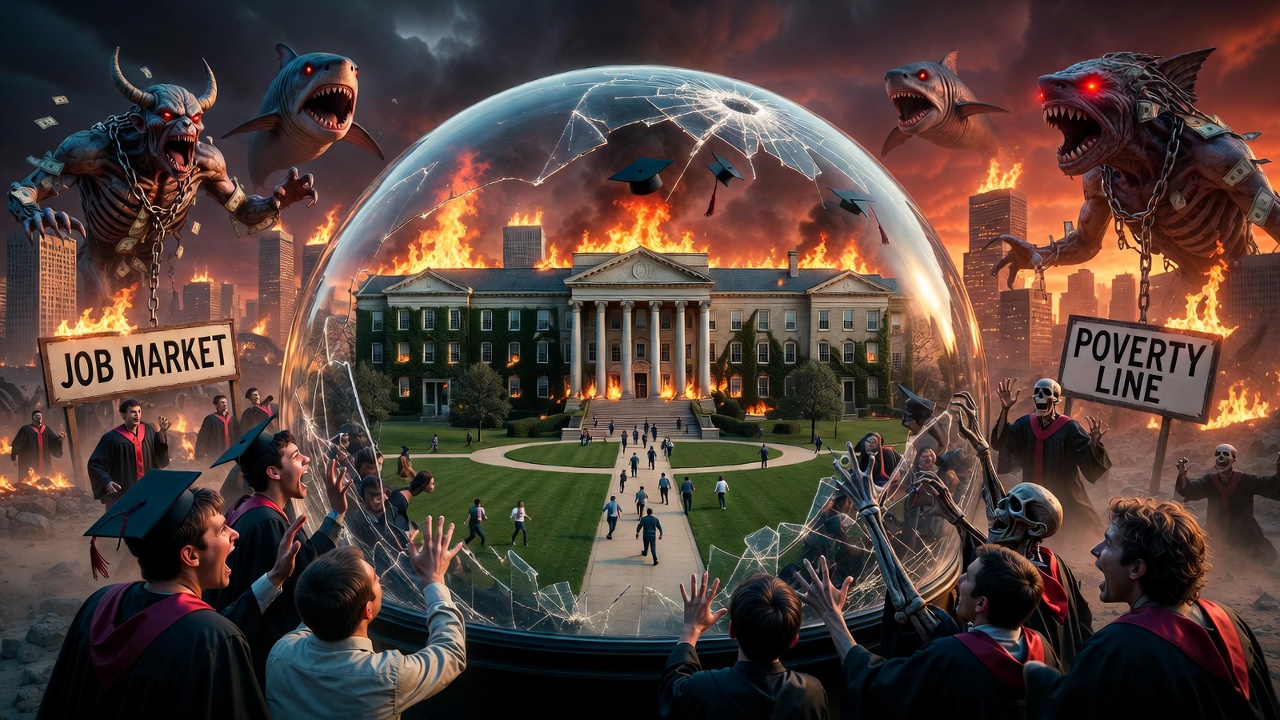
Picture this: It's the 1920s, prohibition is raging, and college? A rarefied club for the elite, with fewer than 1,000 institutions dotting the American landscape and just 48,622 bachelor's degrees handed out in 1920. Fast-forward to today, and higher ed has morphed into a sprawling empire of nearly 4,000 degree-granting schools, pumping out over 2 million bachelor's annually amid a total of millions of postsecondary credentials. Sounds like progress? Think again. With student debt exploding to $1.833 trillion—crushing over 42 million borrowers at an average of around $40,000 each—this "boom" reeks of a bubble fueled by relentless money grabs, from sky-high textbooks to bloated admin salaries. Is college still a smart bet, or just a slick scam leaving grads broke and bitter?
Bubbles inflate when hype meets easy money, and higher ed fits the bill. Tuition has soared dramatically since 1980 (inflation-adjusted), while wages stagnate and jobs demand credentials for gigs that once needed none. Peter Thiel dubs it a racket, where prestige trumps skills, saddling kids with debt for degrees that underdeliver. Defenders argue the lifetime earnings premium makes it worthwhile. But with high underemployment and employers ditching degree requirements, the math's getting shaky.
From Elite Enclaves to Diploma Mills: The Numbers Don't Lie
Back in the flapper era, higher ed was sparse: Around fewer than 1,000 colleges in 1920, enrolling a measly 160,000 students. Degrees were scarce—48,622 bachelor's in 1920, or roughly 50 per 1,000 young adults. By the 1930s, junior colleges added spots, but it was still exclusive.
Cut to recent years: Around 3,931 to 3,982 institutions, enrollment topping 18-19 million, and degrees exploding—an massive leap since 1920. This surge? Thanks to GI Bills, federal loans, and a cultural mantra that college equals success. But it's not all rosy: Enrollment's dipped since peaks, with community colleges hit hard, signaling a potential bust.
Graduation rates tell a tale of lowered bars to keep the cash flowing. At four-year schools, around 61.1% finish in six years—stable in recent cohorts—with publics lower, privates higher, and for-profits lagging. Community colleges hover lower. Critics slam this as grade inflation and standards-dropping to boost stats and lure applicants, turning campuses into degree factories. Surveys show many businesses view degrees skeptically for lacking real skills.
The Real Hustle: Money Grabs Lurking Everywhere
College isn't just pricey—it's rigged with traps to bleed you dry. Start with textbooks: Courses boil down to reading overpriced tomes you barely crack, with students spending around $1,200-$1,370 yearly on books and supplies. Publishers churn "new editions" with minor tweaks to kill used markets, forcing high hits especially for STEM. Access codes for online homework? Another scam, often bundled and non-resellable. Many students skip or drop due to costs.
Then the hidden fees: Orientation, tech, health insurance (if not waived), parking, lab materials. Add lifestyle gotchas—groceries beyond meal plans, travel home, Greek life dues, club fees. Off-campus? Utilities and rent jack costs further.
The big enabler? Administrative bloat. Non-faculty staff ballooned dramatically—up 452% in professionals from 1976-2018, while faculty grew far less. Admins eat big chunks of budgets, funding offices, compliance, and marketing—driving tuition hikes. Luxe amenities like lazy rivers and climbing walls? Pure bait to justify fees, not education.
And loans? The ultimate trap: $1.833T total debt, with rising delinquencies and defaults. Borrowers skip basics to repay. For-profits prey hardest, with poor outcomes and high defaults.
Bubble or Bargain? The Jury's Split
Doomsayers scream yes: Demographic declines, plus alternatives like bootcamps and apprenticeships, threaten closures. Weaker schools fold, elites endure. Optimists counter: Wage gaps persist, rates stable around 61%, global demand sustains. But racial gaps remain stark—and AI disruptions loom.
The Burst or the Slow Leak?
College's inflating, but the pop might be a fizzle: Consolidations, not crashes. Smart moves? Ditch the debt trap for trades or self-learning. As one quip goes, a B.A.'s the new high school diploma—overpriced and overhyped. Time to call the bluff before it bankrupts another generation.
Read more hard-hitting exposés in our full article archive or check out our piece on airline baggage fees hypocrisy.
← Back to Home